Prince’s Life and Legacy: From “Purple Rain” to Paisley Park
Explore Prince’s extraordinary career, his industry battles, and the lasting impact of one of music’s most innovative artists.

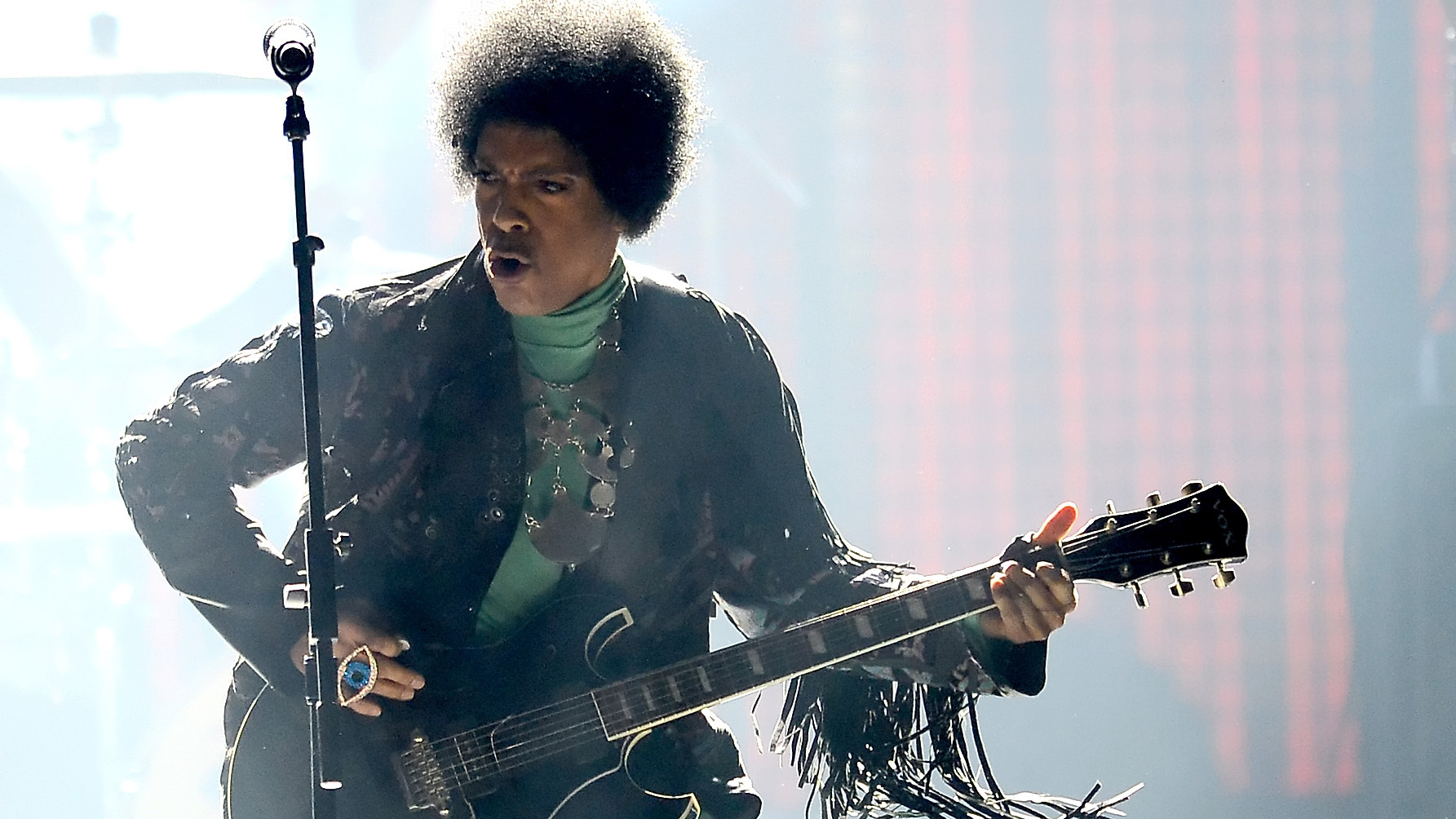
LAS VEGAS, NV – MAY 19: Musician Prince performs onstage during the 2013 Billboard Music Awards at the MGM Grand Garden Arena on May 19, 2013 in Las Vegas, Nevada. (Photo by Ethan Miller/Getty Images)
Prince’s Life, Legacy, and Lasting Impact
Early Life And Musical Beginnings
Prince Rogers Nelson was born on June 7, 1958, in Minneapolis, MI, to musician John L. Nelson (whose stage name was Prince Rogers) and Mattie Della Shaw, a jazz singer who performed in Nelson’s band. Prince taught himself to play the piano at age seven, the guitar at 13, and the drums at 14.
By the time he was 18, a demo tape made its way to a Minneapolis businessman, and in 1978, Prince’s debut album, “For You,” was released. It was followed by his self-titled album, “Prince,” in 1979, on which he played nearly every instrument. The sophomore LP featured the pop and R&B No. 1 hit “I Wanna Be Your Lover,” which brought widespread attention to the multi-instrumentalist with the soaring falsetto and unmistakable style.
Breaking Boundaries in the Early ’80s
Next came the critically acclaimed “Dirty Mind,” released in 1980, which showcased what would become one of Prince’s trademarks: provocative and explicit lyrics. In 1981, he released “Controversy,” featuring the title track and “Let’s Work.”
After releasing “1999” in 1982, Prince was cruising toward pop superstardom. The double album was certified platinum, reached No. 1 on the Billboard 200, and contained the Top 10 singles “Little Red Corvette,” “Delirious,” and the apocalyptic title track, “1999.” “Little Red Corvette” was among the first videos by a Black artist to receive heavy rotation on MTV.
‘Purple Rain’ and Global Stardom
“Purple Rain,” both the album and the semi-autobiographical film released in 1984, propelled Prince to international rock star status. Created with his band The Revolution, the soundtrack album topped the Billboard 200 for 24 consecutive weeks and has sold more than 13 million copies in the United States alone. The album produced multiple chart-topping hits, including “When Doves Cry,” “Let’s Go Crazy,” and “I Would Die 4 U,” as well as the iconic title track, “Purple Rain.”
In 1985, Prince and The Revolution won a GRAMMY Award for Best Rock Performance by a Duo or Group with Vocal, and Prince won the Academy Award for Best Original Song Score for “Purple Rain.”
Creative Risks, Paisley Park, and Industry Battles
His next album, “Around the World in a Day” (1985), debuted at No. 1 on the Billboard 200 and featured the hits “Raspberry Beret” and “Pop Life.” Around this time, Prince opened his own studio complex, Paisley Park, in Chanhassen, Minnesota, which included recording facilities and living quarters.
His next film, “Under the Cherry Moon” (1986), which he directed and starred in, was a commercial disappointment. However, its soundtrack album, “Parade,” yielded the No. 1 hit “Kiss.”
Prince continued releasing albums at a prolific pace. In 1992, he signed a reported $100 million contract with Warner Bros. Records, one of the largest recording and music-publishing deals at the time. After years of disputes over creative control and ownership of his master recordings, he changed his name in 1993 to an unpronounceable symbol. The media began referring to him as the Artist Formerly Known as Prince, or simply The Artist. He resumed using the name Prince in 2000 after his contract with Warner Bros. ended.
‘Emancipation’ and Later Career Highlights
In 1996, Prince released the triple album “Emancipation,” which was certified platinum and featured the hit remake “Betcha by Golly, Wow.” Additional releases followed, including “Crystal Ball” (1998) and “Rave Un2 the Joy Fantastic” (1999), the latter released through Arista Records.
In 2004, Prince was inducted into the Rock & Roll Hall of Fame. In 2006, he released the album “3121,” which debuted at No. 1 on the Billboard 200. The following year, he delivered a widely acclaimed performance at the Super Bowl XLI halftime show, often cited as one of the greatest halftime performances of all time.
In 2014, Prince regained ownership of his master recordings from Warner Bros. under a new agreement that included the release of two albums through the label. He released “HITnRUN Phase One” and “HITnRUN Phase Two” in 2015, initially through the streaming service Tidal.
Death and Enduring Influence
On April 21, 2016, Prince was found unresponsive in an elevator at Paisley Park. He died from an accidental opioid overdose involving fentanyl. His death devastated the music industry and fans around the world.
From the artists he wrote and produced for — including The Time, Sheila E., The Bangles, Sinead O’Connor, Chaka Khan, Sheena Easton, and Celine Dion — to his millions of fans and admirers, Prince’s influence remains immeasurable. Over the course of his career, he released 39 studio albums, along with multiple soundtrack, live, and compilation albums, cementing his legacy as one of the most innovative and hardworking artists in modern music history.