How The Beach Boys’ Groundbreaking ‘Pet Sounds’ Album Changed Pop Music Forever
“Pet Sounds” redefined pop music with groundbreaking production, emotional depth, and lasting influence.

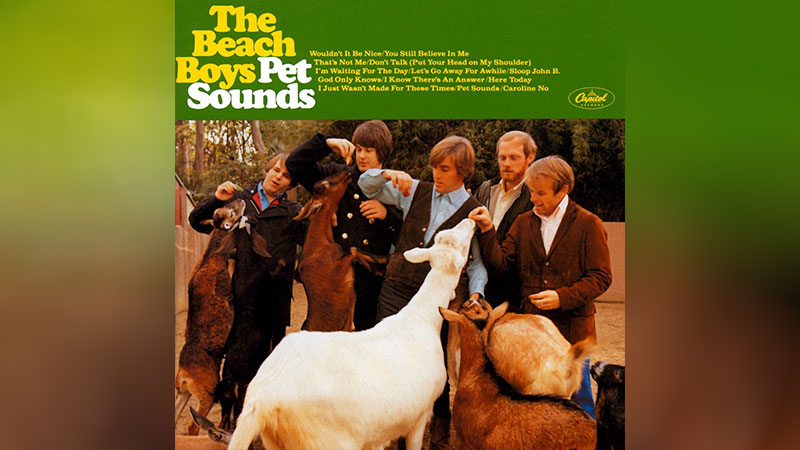
Release Date: May 16, 1966
Backstory Of ‘Pet Sounds’
Before “Pet Sounds,” The Beach Boys had released multiple albums in just a few short years, establishing themselves as America’s premier surf-pop band. In late 1964, co-founder Brian Wilson suffered a panic attack on a flight from Los Angeles to Houston. The incident prompted the 22-year-old songwriter and producer to stop touring with the band and focus exclusively on writing and recording. He was first replaced on the road by Glen Campbell and later by Bruce Johnston.
Freed from touring and inspired by increasingly sophisticated studio techniques, Wilson quickly expanded the group’s sound on albums like “The Beach Boys Today!” and “Summer Days (And Summer Nights!!).” These records marked a clear artistic progression, with more complex arrangements and lyrics that moved beyond cars, surfing, and teenage romance.
Wilson’s creative growth culminated in The Beach Boys’ “Pet Sounds,” widely regarded as one of the greatest albums of all time. Though created under The Beach Boys name, the album is often viewed as Wilson’s artistic statement. It features intricate vocal harmonies, symphonic arrangements, and unconventional instrumentation, including bicycle bells, Coca-Cola cans, sleigh bells, and even recordings of barking dogs.
A Rock Concept Album Ahead Of Its Time
“Pet Sounds” is frequently cited as one of the first true rock concept albums. Its deeply introspective lyrics, written primarily by Wilson and lyricist Tony Asher, paired with lush orchestration and advanced production techniques, transformed expectations of what a pop album could be.
At a time when the 45 rpm single dominated the marketplace, “Pet Sounds” emphasized the LP as a cohesive artistic experience. Its emotional vulnerability and sonic ambition pushed the boundaries of mainstream pop music.
Beatles Approved
Wilson has said he was inspired to create “Pet Sounds” after hearing The Beatles’ 1965 album “Rubber Soul.” The artistic exchange did not end there. In turn, “Pet Sounds” profoundly influenced The Beatles during the making of “Sgt. Pepper’s Lonely Hearts Club Band,” released in 1967.
Producer Sir George Martin wrote in the liner notes of a 1997 “Pet Sounds” box set, “Without ‘Pet Sounds,’ ‘Sgt. Pepper’ never would have happened … ‘Pepper’ was an attempt to equal ‘Pet Sounds.'”
On Rolling Stone’s list of the 500 Greatest Albums of All Time, “Pet Sounds” has frequently ranked near the very top, often placed just behind “Sgt. Pepper’s Lonely Hearts Club Band.”
Commercial Reception And Critical Reappraisal
Although “Pet Sounds” is now hailed as a masterpiece, its initial commercial performance in the United States was modest compared to the band’s earlier releases. The album peaked at No. 10 on the Billboard 200. In the United Kingdom, however, it reached No. 2 and received stronger early critical praise.
Capitol Records released “Best of The Beach Boys” shortly after “Pet Sounds,” and the compilation quickly achieved strong sales. Over time, critics and fans reassessed “Pet Sounds,” elevating it to canonical status as one of the most influential albums in popular music history.
The 50th Anniversary And Beyond
In 2016, fans old and new celebrated the 50th anniversary of “Pet Sounds.” Brian Wilson toured the album in full at festivals, arenas, and theaters around the world, bringing the landmark recording to life for a new generation.
Credits
The Beach Boys:
Brian Wilson (lead, harmony, and backing vocals; organ; piano; production; arrangements)
Mike Love (lead, harmony, and backing vocals)
Al Jardine (lead, harmony, and backing vocals; tambourine)
Carl Wilson (lead, harmony, and backing vocals; guitars)
Dennis Wilson (harmony and backing vocals; drums)
Engineering:
Bruce Botnick, Chuck Britz, H. Bowen David, Larry Levine, and numerous session musicians collectively known as The Wrecking Crew