How “Mrs. Robinson” Became Simon & Garfunkel’s No. 1 Classic
“Mrs. Robinson” became a No. 1 hit in 1968 with its connection to “The Graduate” and Joe DiMaggio lyric

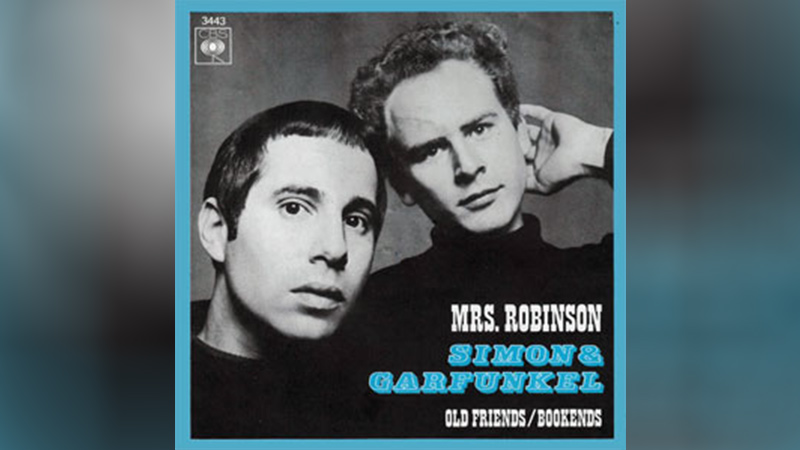
Mrs. Robinson
Backstory
It’s hard to imagine the songs of Simon & Garfunkel guiding the young, disillusioned protagonist of the 1968 classic “The Graduate” as he returns to his parents’ opulent suburban kingdom, fields the obligatory stream of post-grad “What are you going to do with your life?” inquiries, and, of course, navigates the ever-complex Robinson clan.
The soundtrack features several of the duo’s previously released songs. “The Sound of Silence” opens the film as Benjamin Braddock takes a forlorn ride on a moving walkway at Los Angeles International Airport upon his return home from college. Later, as he oscillates between days by the pool and nights in bed with Mrs. Robinson, that track returns, and “April Come She Will” takes over as a languid Dustin Hoffman spends his summer horizontally. “Scarborough Fair/Canticle” also soundtracks Braddock’s aimlessness and increasing melancholy as he deals with the consequences of dating the daughter of the woman with whom he has been sleeping, and later makes the trek to Berkeley to try to win her back. (“But what if she doesn’t want to marry you?” his mother asks. He’ll figure that one out when he gets there.)
Interestingly, the song most associated with the film, “Mrs. Robinson,” does not appear in full in the movie, nor on the original soundtrack album. The film premiered in December 1967, and Paul Simon and Art Garfunkel recorded the full hit version of “Mrs. Robinson” in early 1968. The soundtrack LP was released in January 1968. Forever linked in music and movie fans’ memories with the landmark motion picture, the song went on to hit No. 1 on the Billboard Hot 100 in June 1968 and won two GRAMMY Awards, including the coveted Record of the Year award — the first time a rock song received that honor.
“Here’s to You, Mrs. Robinson”
Director Mike Nichols was such a fan of the duo that he reached out to Columbia Records chairman Clive Davis to license their songs for the film, eventually convincing Paul Simon to write original material specifically for “The Graduate.” Extensive touring delayed the process, and Nichols was reportedly unimpressed when presented with “Punky’s Dilemma” and “Overs,” both of which would later appear on the 1968 album “Bookends.”
However, when Nichols heard a snippet of an unfinished number featuring the lyric “Here’s to you, Mrs. Roosevelt,” he famously replied, “It’s not Mrs. Roosevelt, it’s Mrs. Robinson,” and the rest was history.
Where Have You Gone, Joe DiMaggio?
Perhaps the song’s most famous line, the reference to Joe DiMaggio, seemed to come out of nowhere. As Simon once told SongTalk magazine, “The Joe DiMaggio line was written right away in the beginning. And I don’t know why or where it came from. It seems so strange, like it didn’t belong in that song, and then, I don’t know, it was so interesting that we just kept it.”
Mickey Mantle might have been a more obvious name-check for Simon, whose New York Yankees fandom peaked during Mantle’s years. When the baseball legend asked why DiMaggio was the chosen name during a commercial break on Dick Cavett’s talk show, Simon reportedly replied, “It’s about syllables, Mick. It’s about how many beats there are.”
The light drama continued years later when Simon met DiMaggio at an Italian restaurant in New York. According to Simon, DiMaggio questioned the lyric, asking why Simon wondered where he had gone. “I just did a Mr. Coffee commercial, I’m a spokesperson for Bowery Savings Bank, and I haven’t gone anywhere,” DiMaggio reportedly said. The two eventually patched things up, and Simon honored the baseball icon upon his passing with an op-ed in The New York Times.