Author Martin Goldsmith Remembers George Martin’s Legacy with The Beatles
George Martin was a driving force in the music-making of history’s greatest and most lasting rock ‘n’ roll band.

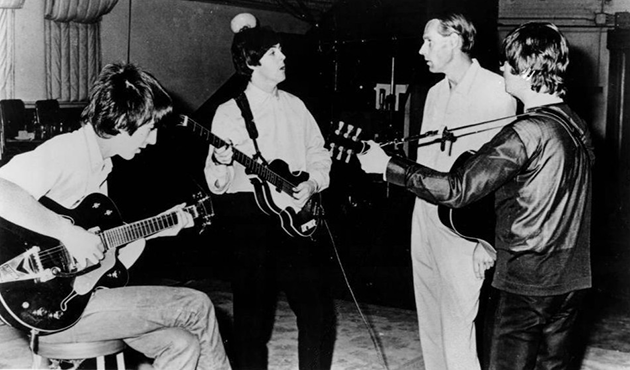
In 1962, when he signed The Beatles to a record contract with Parlophone (a division of EMI), George Martin was 36 years old, 14 years older than the oldest Beatles, John Lennon and Ringo Starr. Although he hailed from North London, the son of a carpenter, Martin spoke with the quiet, clipped, authoritative voice of a BBC newsreader, which in fact he had been.
He also could point to a solid musical background. He had been the pianist and leader of his own dance band, George Martin and the Four Tune Tellers; he had studied music at the prestigious Guildhall School, concentrating on conducting, composition, orchestration, music theory, and piano performance; and he had learned to play the oboe well enough to freelance his way through several jobs with London’s many fine orchestras.
As a record producer he’d worked with classical musicians, jazz artists, and comedians, including the mad trio of Peter Sellers, Spike Milligan, and Harry Secombe, better known as The Goons. It was his background in Goonery that first attracted the Beatles to work with Martin, but he called upon all of his extensive musical background to add immeasurably to the band’s inimitable sound.
His influence was apparent from the start, as he took a nice song from John Lennon called “Please Please Me” and helped make it their first No. 1 single. John had conceived of the song as a slow, Roy Orbison-type ballad. Martin suggested that the song really needed to be a faster, up-tempo number that emphasized the plea that the song’s protagonist was making to his girlfriend.
It was Martin who suggested that John’s harmonica, which had been such an integral part of the sonic texture of their first single, “Love Me Do,” should make an immediate appearance at the top of their next record, and it helps kick off “Please Please Me” with a bright, edgy exuberance. And it was Martin who devised the rapid-fire chords that underlie the stratospheric voices of John and Paul McCartney at the song’s exultant ending.
From there, through his brilliant suggestion of a string quartet to accompany Paul’s guitar on “Yesterday” to his introduction of a Moog synthesizer on the band’s epic finale, the “Abbey Road” album, Martin was a driving force in the music-making of history’s greatest and most lasting rock ‘n’ roll band.
Martin Goldsmith is the author of “The Beatles Come To America.”