Stevie Wonder’s Greatest Songs, Albums, and Awards: A Complete Career Timeline
Celebrate Stevie Wonder’s legendary career, timeless songs, and groundbreaking albums that shaped pop and R&B history.

Early Life and Musical Beginnings
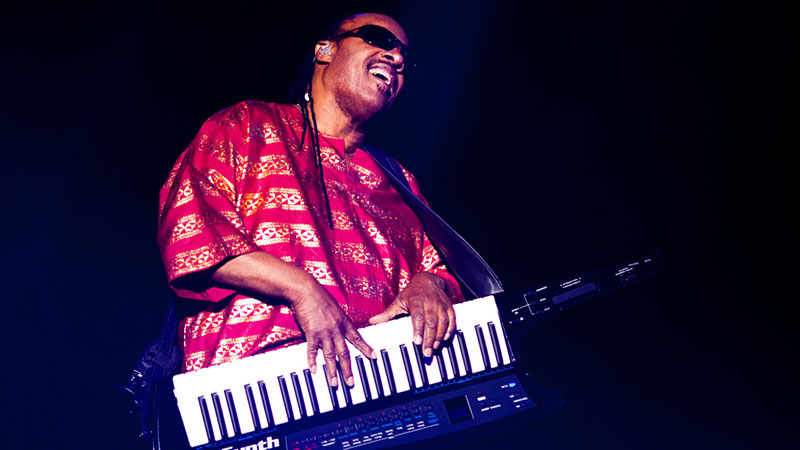
Stevie Wonder has been blessing the world with his divine voice, joyful up-tempo jams, and exquisite ballads since he was a preteen. Very few artists have had such a long, illustrious, and successful career. Wonder is a musical genius whose vast catalog of songs will be celebrated for many years to come.
Steveland Hardaway Judkins (later Morris) was born six weeks premature in Saginaw, Michigan. As a result of receiving too much oxygen in an incubator, he developed retinopathy of prematurity and lost his sight. His disability did not prove to be a hindrance. As young as 4 years old, Wonder developed an affinity for music, singing in the church choir in Detroit after his family moved there. He later taught himself to play the harmonica, piano, and drums before the age of 10.
Motown Discovery and Early Hits
At just 11 years old, Wonder was discovered by Ronnie White of the Motown group the Miracles. He eventually auditioned for Motown founder Berry Gordy Jr., who signed the child prodigy to the label. Renamed Little Stevie Wonder, he released a few early singles that did not gain much traction, but “Fingertips (Pt. 2),” released in 1963, became his breakthrough smash, reaching No. 1 on the Billboard Hot 100.
Two years later, “Uptight (Everything’s Alright)” became a Top 10 hit, followed by his cover of Bob Dylan’s “Blowin’ in the Wind,” which reached No. 9 on the pop charts and No. 1 on the R&B chart. It was around this time that Wonder dropped “Little” from his stage name.
Creative Control and a Historic Album Run (1972–1976)
There was no stopping him after that. As he came into adulthood, Wonder released a string of hits in the late 1960s and early 1970s that showcased his remarkable talent. “I Was Made to Love Her,” “For Once in My Life,” “My Cherie Amour,” and “Signed, Sealed, Delivered I’m Yours” were major hits that made Wonder a household name. After turning 21 in 1971, Wonder renegotiated his Motown contract, becoming one of the first artists at the label to gain full artistic control over his music.
Between 1972 and 1976, Wonder released an extraordinary run of albums: “Music of My Mind,” “Talking Book,” “Innervisions,” “Fulfillingness’ First Finale,” and the sprawling double album “Songs in the Key of Life.” Each was as creative and impassioned as the last. These albums produced a bevy of classics, including “Superstition,” “You Are the Sunshine of My Life,” “Living for the City,” “Higher Ground,” “You Haven’t Done Nothin’,” “Boogie On Reggae Woman,” “I Wish,” “Sir Duke,” “Isn’t She Lovely,” and “Love’s in Need of Love Today.”
Wonder also won numerous GRAMMY Awards during this period. “Innervisions” won three GRAMMYs, including Album of the Year. “Fulfillingness’ First Finale” also won Album of the Year in 1974. “Songs in the Key of Life” topped the Billboard 200 chart and won four GRAMMYs, including Album of the Year. All three albums consistently rank among Rolling Stone’s 500 Greatest Albums of All Time.
Continued Success in the 1980s
The 1980s were somewhat quieter compared to the 1970s, but Wonder continued to produce major hits. His album “Hotter than July” yielded “Master Blaster (Jammin’)” in 1980. Never one to shy away from social issues, Wonder helped lead the campaign to establish Martin Luther King Jr. Day as a national holiday, aided by his song “Happy Birthday.” In 1982, he partnered with Paul McCartney for the No. 1 hit “Ebony and Ivory.” In 1984, “I Just Called to Say I Love You,” written for “The Woman in Red” soundtrack, became one of Motown’s biggest international hits and earned Wonder an Academy Award for Best Original Song.
In 1985, “Part-Time Lover” from “In Square Circle” reached No. 1 on the pop, R&B, adult contemporary, and dance charts — making Wonder the first artist to achieve that feat with a single song. In 1986, he scored another No. 1 hit as a featured artist on Dionne Warwick’s charity single “That’s What Friends Are For,” alongside Elton John and Gladys Knight.
Later Career, Honors, and Legacy
“Characters” (1987) and the soundtrack to Spike Lee’s “Jungle Fever” (1991) were more modest commercial successes but still charted respectably. In 1989, Wonder was inducted into the Rock and Roll Hall of Fame. He received the GRAMMY Lifetime Achievement Award in 1996. In 1995, he released “Conversation Peace,” his first new studio album in eight years.
In 2005, Wonder released “A Time to Love,” his first album in a decade. The album featured guest appearances by Prince, Paul McCartney, India.Arie, En Vogue, and his daughter Aisha Morris. The single “From the Bottom of My Heart” earned him a GRAMMY Award for Best Male Pop Vocal Performance.
Since then, Wonder has continued performing at major events, including the We Are One: The Obama Inaugural Celebration at the Lincoln Memorial in January 2009. That same year, he was awarded the Gershwin Prize for Popular Song by the Library of Congress, presented at the White House by President Barack Obama. Wonder remains active in philanthropy, supporting causes including HIV/AIDS awareness, disability advocacy, and assistance for the homeless.
A Lasting Musical Impact
Stevie Wonder is a pop and R&B icon, a humanitarian, and one of the few artists with more than 30 Top 10 hits. He is an exceptionally talented singer, songwriter, and multi-instrumentalist whose music is woven into the fabric of American culture. Everyone has a favorite Stevie Wonder song — or two or three — and we are grateful for the joy and brilliance he has given the world.