


























Muhammad Ali’s Journey to Becoming the First Three-Time Heavyweight Champion
His path to being “The Greatest” started with a single step: defeating Liston in 1964.

AP Photo
Before Muhammad Ali was dubbed “The Greatest,” he was Cassius Clay, an up-and-coming contender in boxing’s heavyweight division who was the biggest loudmouth trash-talker the world had ever seen. His antics of belittling his opponents while touting his own skills made him disliked by his peers, the media, and most of the general public.
Cassius Clay vs. Sonny Liston
Clay had solidified himself as the top contender for Sonny Liston’s world heavyweight championship by late 1963, earning a title shot on February 25, 1964, at the age of 22.
Poking the Unbeatable Bear
Liston had an intimidating demeanor as the strong, silent type who could destroy any man with his hands, evidenced by his utter dismantling of former heavyweight champion Floyd Patterson with two first-round knockouts. Many believed Liston was unbeatable, and multiple boxers were reluctant to meet him in the ring. Still, Clay wasn’t afraid to poke the bear during the buildup to the fight.
“Liston even smells like a bear,” he said. “After I beat him, I’m going to donate him to the zoo.”
Clay turned up the mental warfare at the prefight weigh-in, yelling insults at Liston the entire time and even declaring, “Someone is going to die at ringside tonight.” He revealed his strategy to avoid Liston’s attack (“Your hands can’t hit what your eyes can’t see”) and counter-punch (“Float like a butterfly and sting like a bee”). Liston remained undaunted and predicted that Clay would be finished within two rounds. The media also wasn’t impressed, thinking Clay’s behavior was a sign of fear.
Little did they know his supreme confidence was no act.
The First Cut Is the Deepest
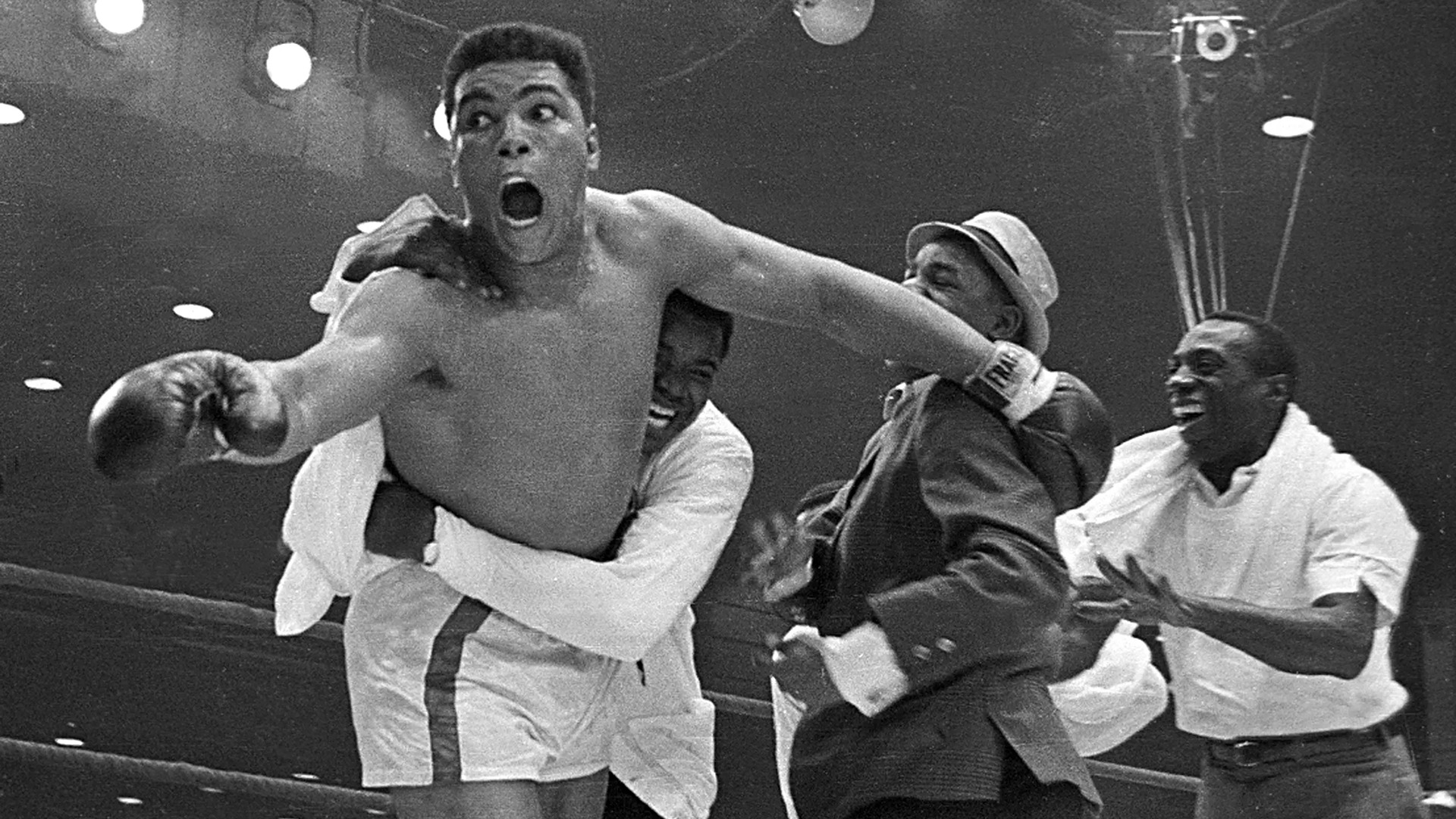
From the start of the fight, the effects of Clay’s trash-talk were immediately evident as Liston charged him angrily, looking to end the fight early. But Clay’s superior speed and movement allowed him to slip Liston’s lunging punches, leaving the champ flailing and swinging at the air. Liston’s best moment came in the second round when he was able to corner Clay against the ropes and catch him with a left hook, but he was unable to follow up with more punishing blows. Clay took control in the third round and landed several combinations, causing a cut under Liston’s left eye — the first time he had ever been cut in his career.
After the sixth round ended, Liston told his cornermen, “That’s it,” and didn’t answer the bell for the seventh round.
The Ali Shuffle
Clay moved to the middle of the ring with his arms raised and danced a jig that would forever be known as the “Ali Shuffle.” He ran to the ropes and yelled at the sportswriters sitting ringside, repeatedly shouting, “Eat your words,” “I shook up the world,” and “I’m the greatest.”
The two fought again in 1965, and Liston was knocked out in the first round. Clay stood over his fallen opponent, yelling, “Get up and fight, sucker!” in one of the most iconic moments in sports history.
Becoming Muhammad Ali
Two days after winning the title, Clay announced that he was a member of the Nation of Islam. He started going by Cassius X before Elijah Muhammad, the leader of the Nation of Islam, renamed him Muhammad Ali on March 6, 1964.
What’s My Name?
Ali defended his title eight times after the second Liston fight. His fight against Ernie Terrell in 1967 was noteworthy because of Terrell’s insistence on calling Ali “Clay’; Ali called Cassius Clay his “slave name.” During the fight, Ali would taunt Terrell in between punches, yelling, “What’s my name, Uncle Tom, what’s my name?!” before winning a unanimous 15-round decision.
The Vietnam War
Four of Ali’s title defenses took place in Canada and Europe because his stance on the Vietnam War caused athletic commissions to refuse to sanction his fights. In February 1966, Ali was reclassified by the Louisville draft board as 1-A, but he publicly indicated he would refuse to serve, saying, “I ain’t got nothing against no Viet Cong; no Viet Cong never called me n—-r.”
After his title defense against Zora Folley on March 22, 1967, Ali was stripped of his title due to his refusal to be drafted into the army. He was convicted of draft evasion in June and sentenced to five years in prison, but remained free while he appealed the verdict after paying a bond. Every state refused to grant him a boxing license, forcing him out of the sport until late 1970.
During his time away from the sport, Ali spoke at colleges across the nation, criticizing the war. People sympathized more and more with his stance as opposition to the Vietnam War grew substantially over time. Ali’s conviction was overturned by the Supreme Court by a unanimous 8-0 decision on June 28, 1971.
Back in the Ring
Once Ali’s boxing license was reinstated, he was a part of some of the best fights in history despite sitting on the sidelines for what most would consider his prime (25-29 years old).
The Fight of the Century
Ali met the heavyweight champion Joe Frazier in the “Fight of the Century” at Madison Square Garden on March 8, 1971. His trash-talking of Frazier was looked at as cruel and unfair, as he frequently called Frazier an “Uncle Tom” and insisted that only white people rooted for him. The mind games didn’t work the way they worked on Liston, though, as Frazier handed Ali his first professional loss by unanimous decision.
The Rumble in the Jungle
Ali earned a unanimous decision win over Frazier in a rematch on January 28, 1974, to earn a shot at George Foreman’s heavyweight title. In “The Rumble in the Jungle” in Kinshasa, Zaire, on October 30, 1974, many thought Ali had no chance of winning, but he employed the “Rope-A-Dope” strategy to tire Foreman and knock him out in the eighth round for his second heavyweight championship.
The Thrilla in Manila
Ali met Frazier for the final time on October 1, 1975, in the “Thrilla in Manila.” It was a back-and-forth battle that saw huge momentum swings. Ali came on strong in the later rounds, dominating the 13th and 14th and forcing Frazier’s trainer to stop him from answering the bell for the final round.
Ali called the TKO victory the hardest fight he’s ever been in, saying it was “the closest thing to dying that I know.”
First Three-Time Heavyweight Champion
Ali won the heavyweight belt one more time in 1978 against Leon Spinks, making him the first three-time heavyweight champion in boxing history. He retired in 1979 but fought two more fights afterwards, losing both. Ali was diagnosed with Parkinson’s syndrome in 1984.
Ali remains an iconic figure today for everything he’s done inside and outside of the ring. There has yet to be another athlete who has matched his social, political, and societal impact. His path toward becoming “The Greatest” started with a single step: defeating Liston in 1964.